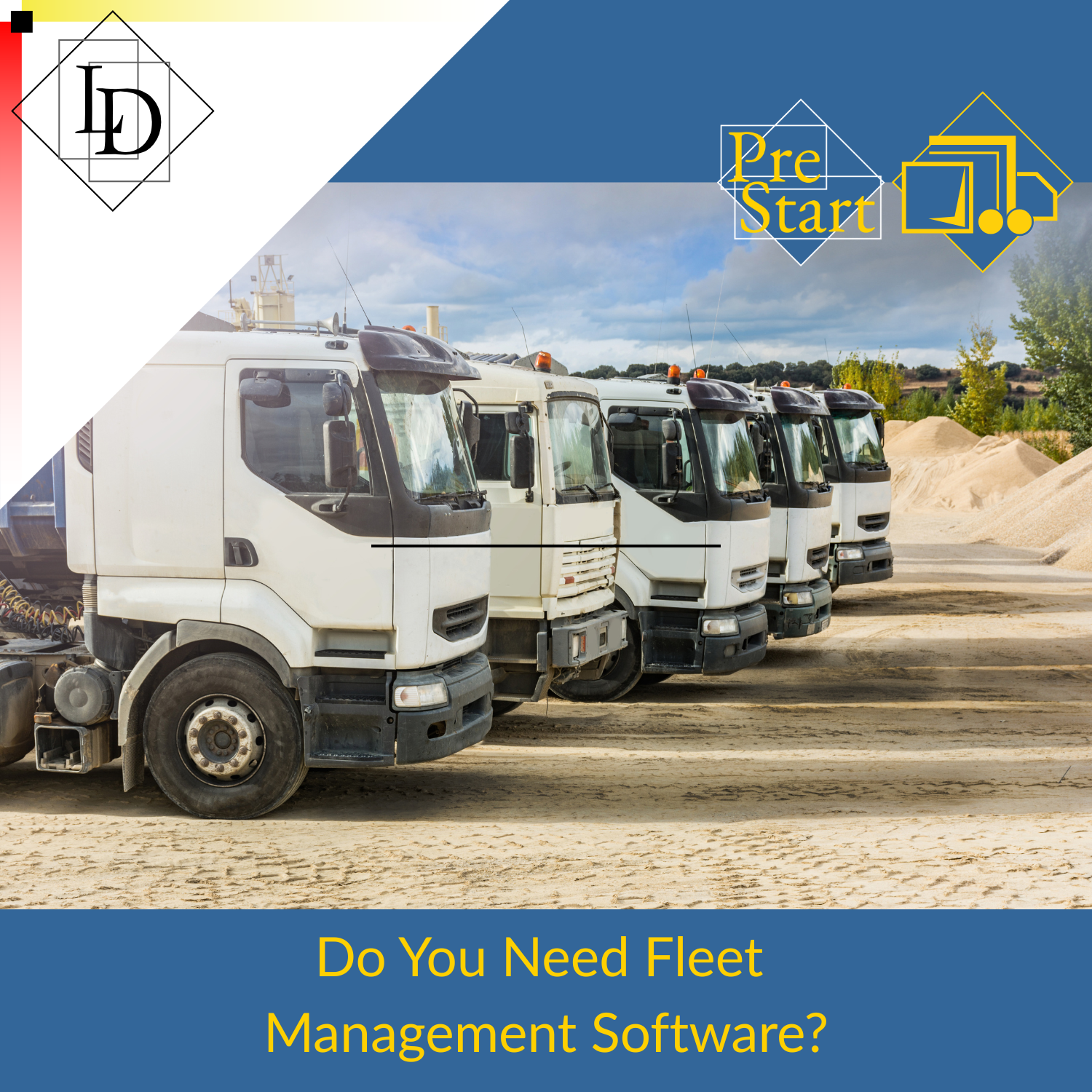
Do You Need Fleet Management Software? [2026 Guide]
If you're running a transport or logistics business, you've probably asked yourself at some point, "Do we actually need fleet management software, or can we keep managing things the way we always have?"
For smaller operations, spreadsheets, phone calls, and paper-based processes can work for a while. Jobs get assigned, drivers complete deliveries, and things move—most of the time. But as the business grows, these systems start to show cracks. Missed updates, delays, double handling of information, and a lack of real-time visibility can quickly start costing you.
That's usually the point where the question shifts from "Do we need software?" to "How long can we keep operating without it?"
In this guide, we'll break down when fleet management software actually becomes necessary, the warning signs to watch for, and what to look for in a solution built around how Australian transport businesses actually operate.
 Source: Photo by Bhargav Panchal on Unsplash
A Growing Industry with Growing Complexity
Australian road freight is a significant and expanding industry. According to IBISWorld, the sector was valued at $74.9 billion in 2024, with more than 61,000 businesses operating nationally. The Bureau of Infrastructure and Transport Research Economics (BITRE) projects road freight volumes will grow by 77 per cent between 2020 and 2050, driven by population growth and rising consumer demand.
That growth brings real opportunity, but also real pressure. More freight means more consignments, tighter margins, and greater operational complexity. NatRoad reported over 26,000 unfilled truck driver positions in Australia in 2024, with 49 per cent of road freight businesses citing severe difficulty finding drivers. Doing more with less isn't a future challenge for Australian transport businesses—it's the present reality.
Fleet Management vs Transport Management: What's the Difference?
These two terms get used interchangeably, but they're not the same—and choosing the wrong category of software can leave real gaps in your operation.
Fleet management software is focused on the vehicles. Location tracking, fleet maintenance scheduling, fuel monitoring, driver behaviour. It answers the question: where are my assets, and are they in good condition?
Transport management software covers the entire consignment process: quoting, booking, dispatch, delivery, invoicing, and reporting. It answers a bigger question: is the whole operation running the way it should?
For most freight businesses, the second question is the one that drives profitability. Fleet maintenance matters—but it's one component of a much larger picture. If your consignment process is still running on paper and phone calls, real-time truck tracking doesn't solve the underlying problem.
Signs Your Current Setup Is Holding You Back
These are the patterns that tend to emerge when a transport operation has outgrown its systems:
- Jobs are slipping through the cracks. Not because of carelessness—because there's no system catching things when people are stretched.
- Invoicing is always a step behind operations. When billing is disconnected from the job itself, errors creep in and cash flow slows down.
- Nobody has a clear picture of what's happening. Without centralised visibility, you're always reacting rather than managing.
- Information is being entered more than once. Any time data needs to be re-keyed from one system to another, you're paying twice for the same task and introducing errors along the way.
- Customer queries are eating into the day. If answering "where's my freight?" requires chasing three people, that's a systems problem—not a staffing one.
If two or more of these are familiar, the honest answer is that more spreadsheets won't fix it. The problem is structural.
 Source: Photo by Hoi An and Da Nang Photographer on Unsplash
What to Look for in Transport Management Software in Australia
Not all transport management software Australia businesses consider will suit the operational realities of running freight locally. Here's what actually matters:
End-to-end job management. From quote to invoice, the entire consignment lifecycle should live in one place. Jumping between disconnected systems to complete a single job is inefficient and error-prone.
Integration with your accounting platform. Good transport management solutions work alongside MYOB or Xero. Replacing your accounting software shouldn't be a condition of getting your operations under control.
Cross-platform access. Transport management software that only works on a desktop solves half the problem. Drivers on the road need access too.
Local, responsive support. When something goes wrong with trucks on the road, you need to reach someone who understands Australian compliance requirements—not submit a support ticket and wait.
Room to grow. The right system expands with your business through a modular approach, without requiring a complete overhaul every time your operation scales.
How ConNote Handles It
ConNote by Logical Developments has been purpose-built for Australian freight and transport businesses since 1997. Built on a modular, fully customisable foundation, it manages the entire consignment process—from first quote through to final invoice—in a single system, integrating with your existing accounting software so nothing needs to be replaced.
Unlike off-the-shelf platforms where you configure your business around the software, Logical Developments works directly with each client to build around how the operation actually runs.
Bishop's Transport are a practical example. When their freight volumes grew and their paper-based process couldn't keep up, they moved to ConNote. The result was ten consignment notes completed and manifested to a trailer in two minutes—a process that had previously taken significantly longer by hand. Read the full case study for the full picture.
So, Do You Actually Need It?
The transport industry is only getting busier, more competitive, and more demanding on the businesses operating within it. Manual processes that worked at lower volumes become liabilities as freight grows—and by the time the cracks are obvious, they've usually been costing the business for a while.
If your operation is scaling, your admin is piling up, or your team is spending more time managing process than moving freight, then the answer is yes. And the right starting point is a straightforward conversation about what your operation actually needs.
Get in touch with the Logical Developments team (https://www.logicaldevelopments.com.au/contact) and have a straight-forward conversation about where things are at. No hard sell—just an honest look at whether there's a better way to run your operation.
Sources:
- IBISWorld (https://www.ibisworld.com/australia/industry/road-freight-transport/456/), Road Freight Transport in Australia, 2024–2025
- Bureau of Infrastructure and Transport Research Economics (BITRE) (https://www.bitre.gov.au/), Australian Aggregate Freight Forecasts, 2022 Update
- NatRoad (https://www.natroad.com.au/), Road to 2028, 2025